Matters of the Heart
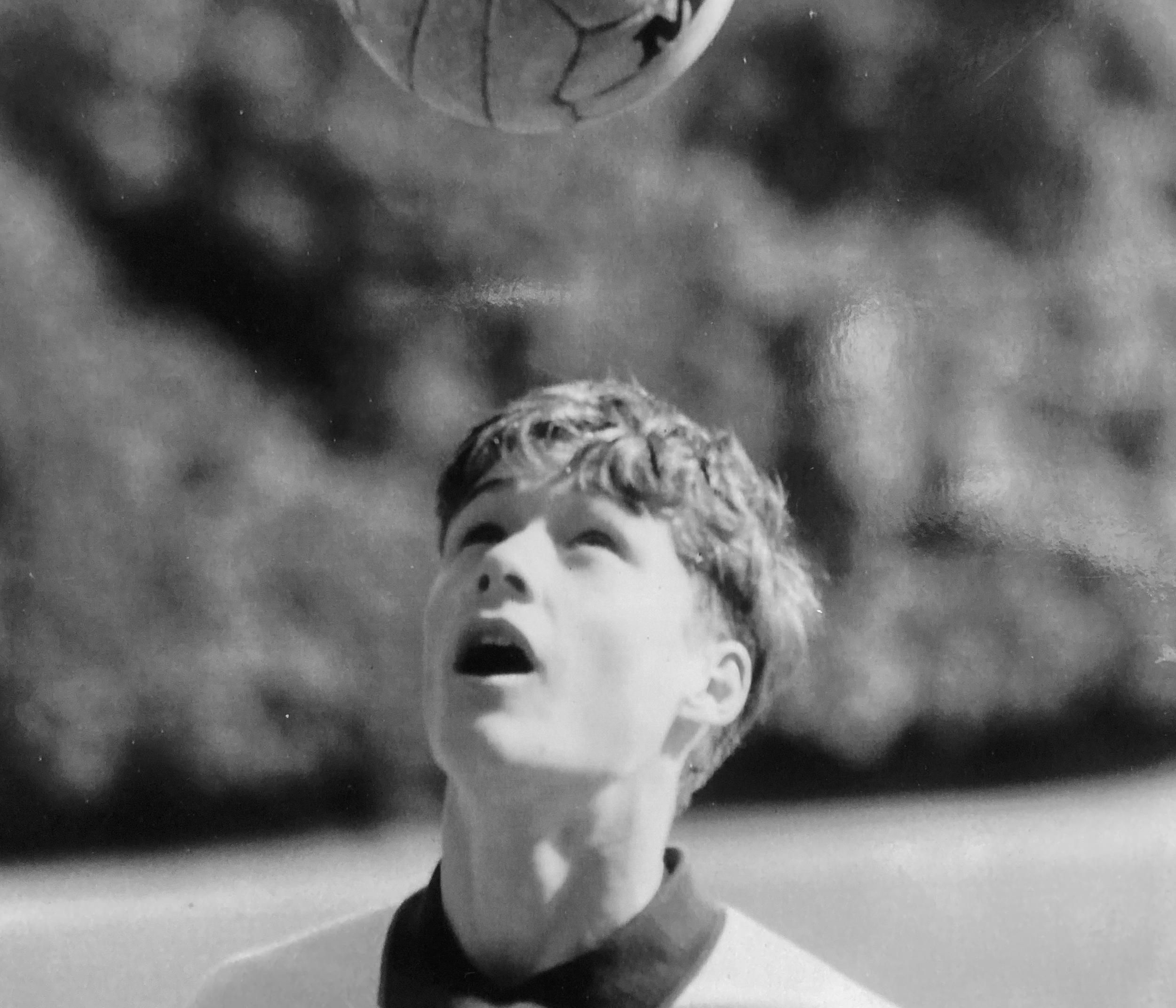
The Marshall Family
Hayley Crosbie keeps in her back pocket a charming story about Kevin Keegan.
When she was nine years old, Hayley and her family were visiting Anfield. Keegan wanted to sign her brother, John Marshall, for Newcastle United. He was willing to throw a Rover car into the offer and asked Hayley if she wanted anything.
Keegan agreed to her ambitious request for a limousine and the entire conversation took place in the office of Roy Evans, who was also pursuing John as Liverpool manager. Manchester United and Everton were interested too. Blackburn Rovers and Aston Villa were. Everybody was.
The Marshalls had returned to the north-west from Bournemouth. As soon as the football fraternity learned that John was leaving Portsmouth, the phone at the new home of his parents, Maureen and John, started to ring.
By 1995, John was a graduate of Lilleshall, the Football Association’s residential school of excellence. He was an England Schoolboy international and had played at Wembley.
An obsessive Liverpool supporter, John made his choice. He went with a young Reds group to take part in some matches in Paris. Then he came back to England and signed for Joe Royle and Everton.
In the summer of 1995, John collapsed at home. He died in hospital in Ormskirk on 3rd July, the day he was due to start as a YTS trainee at Bellefield.
“He only ever called me Maureen,” John’s mum tells me. “He did that until the day we lost him. He was very, very funny. Very dry. Our John was never without a ball. All he did was play football.”
“John had all the time in the world for me,” says Hayley. “We were very close. He was one of those annoying people who can do everything, only he wasn’t annoying. He could have been a cricketer or a runner. He was going to be a footballer. But he was very modest.”
Hayley and John had two cousins in the school. One was a friend and classmate of mine, the other a regular visitor to my house with my younger brother. John’s aunt was close to my mother for years.
When John passed away, I played for the primary school football team he’d left behind years earlier. He was idolised by the teachers involved in football at St Walburga’s in Bournemouth, so much so that we were taken to Wembley to watch him play.
Protection born in tragedy
John died from Arrythmic Right Ventricular Cardiomyopathy (ARVC), an undiagnosed heart condition, ten days before he and Everton’s other YTS signings were due to become the first footballers to undergo heart screenings conducted by Professor Bill McKenna. It had been arranged by Les Helm, Everton’s club physiotherapist.
“Whether that would have saved his life, we don’t know,” says Hayley. “He might have needed a heart transplant by that time.”
“I didn’t know that the hospital had sent John’s heart down to Bill in London,” adds Maureen. “Because John was such a fit lad, Bill wanted to know more.”
Without that proactive intervention, John’s condition might never have been identified and the path of one of the UK’s most important cardiac charities would have been different.
“Cardiac Risk in the Young (CRY) was founded in 1995 to support families after a tragedy but also to try to prevent the tragedy in the family from occurring,” says Dr Steven Cox, the charity’s CEO.
“The foundation of CRY really came around a few stories. The first was my story, which was being identified with a condition and tennis getting involved with screening of players.
“Then we had two high-profile deaths in sport: Daniel Yorath and then John Marshall, whose death really coincided with the launch of CRY.”
CRY is as much a platform for the charitable efforts of bereaved families as a charity in its own right. Thirty years in, the depth and scope of the threat it stares down gets ever clearer, illuminated by CRY’s formidable research programme.
There are 600 sudden deaths among young people in the UK every year. Along with suicide and accidents, it’s one of the most common causes of death in young men.
Along with research, the thrust of CRY fundraising is to facilitate the heart screenings that can surface conditions like ARVC before the worst happens.
Professor Aneil Malhotra is a professor of sports cardiology at the Institute of Sport at Manchester Metropolitan University and a consultant cardiologist in Manchester. He works with the FA to understand the data that emerges from its screening programme, which was, eventually, a consequence of John’s tragic loss.
“It’s the longest-standing screening programme in Europe and one of the most comprehensive, in that they do an ECG which is an electrical scan of the heart, and an echocardiogram, which is an ultrasound scan of the heart,” Aneil explains.
“We’re looking for inherited heart conditions that may predispose a young person to sudden cardiac death, such as heart muscle disorders, the heart wall being too thick, the heart cavity perhaps being too large, or any structural defects or any electrical problems.
“The reason we look for these is that we know that if you’re harbouring a condition then you’re up to three times more likely to run into problems. Your heart may run into a funny rhythm which can lead to a tragic event such as cardiac arrest.
“In up to 80% of cases, the young person who dies is asymptomatic. That’s a very compelling reason for actively looking for at-risk individuals.”
ECG has a 90% detection rate for abnormal life-threatening heart conditions and 30 years of data has enabled Aneil and his colleagues to achieve a massive reduction in false positives and a much more detailed interpretation of results than was possible when McKenna began scanning the hearts of young footballers in 1995.
Screenings aren’t cheap. In common with most CRY fundraising, it’s the families who generate the money to cover the costs, which have risen to around £6,000 to cover free screening of 100 people between the ages of 14 and 35.
In the lifetime of the John Marshall Fund, his family has funded screening for more than 1,500 people and raised more than £100,000 in his name.
I tell Hayley that I won a signed Aston Villa football in the raffle at a charity football match held in John’s name at Dean Court soon after he passed away.
“Doug Ellis was one of the first to make a donation to the John Marshall Fund,” she says. “He put a fiver in.”
Cardiac events in the spotlight
In conversation with Hayley, Maureen and Aneil, it’s obvious that the high-profile cases of Fabrice Muamba and Christian Eriksen have raised awareness of undiagnosed heart issues in athletes.
Those two players survived where many others have not. The ability to deliver emergency treatment to them on the pitch was paramount.
“With every minute that CPR is delayed, the chances of a successful resuscitation fall by 10%,” says Aneil.
“Even when people are screened as a primary level of prevention, things can unfortunately slip through the net.
“No test is 100% foolproof and that just goes to show the importance of a secondary prevention in the form of being able to call for help, to identify someone who has collapsed and try to get a defibrillator on and have someone who’s able to use it.”
My football club, Coventry Sphinx, is required along with others at our level, to have a defibrillator on-site and accessible. The vast majority of visitors to the club, players or not, have not been screened. Secondary prevention is vital.
“We have to have a defibrillator and it has to be part of our medical evacuation plan, not just for players but also for spectators,” club secretary Sharon Taylor tells me.
“It’s logged with the ambulance service so anybody using the site for anything other than football can get the code and have access to it too.”
For the 2025/26 season, Sphinx’s home stadium at Sphinx Drive has been renamed as the Cameron Slater Arena in memory of another young man who sadly lost his life much more recently.
“Our chairman, Joey Fletcher, was good friends with Cameron’s dad,” says Sharon.
“The idea is that we try to raise money for Cardiac Risk in the Young. We’ve had a really great start to the fundraising and we’re planning a number of different events. One of the games this season will be allocated as a bucket shake for CRY.
“I’m so proud that we’ve taken this opportunity to highlight something that is so important.”
I’m proud too. Three decades after John Marshall passed away, seeing Cardiac Risk in the Young supported by my club in an entirely different part of the country from where I grew up in the south and where John’s family now lives in the north feels like a meaningful continuation of his legacy.
John went on holiday with his close friend, Michael Branch, and a group of fellow Lilleshall leavers before starting at the club. His family’s testimony from the time suggests he returned to England tired and never returned to his old self.
Even now, Hayley and Maureen are full of praise for Everton. The club dealt with the awful business that follows the unexpected death. They looked after John’s family and paid for his funeral. Afterwards, the hard work of raising money began.
Thanks to CRY, to the Marshall family and others, to researchers like Aneil, lives have been saved. Steven Cox believes that technology will continue that positive trajectory.
“We want every young person to routinely have the option to have their heart tested, whether that is yearly or more sporadic. That will be determined by research into how frequently it should be done,” he tells me.
“With technology that’s hitting the market now, I’m very confident that monitoring the heart in a home setting is not very far away.”
This essay was written for and originally published by MUNDIAL, which owns all of the written content within.
As a result of it no longer being available to read anywhere due to changes at MUNDIAL, I have assumed ownership of the essay and republished it here.